
Partial dentures in Hobart.
Fill the gaps in your smile and keep the natural teeth you have.
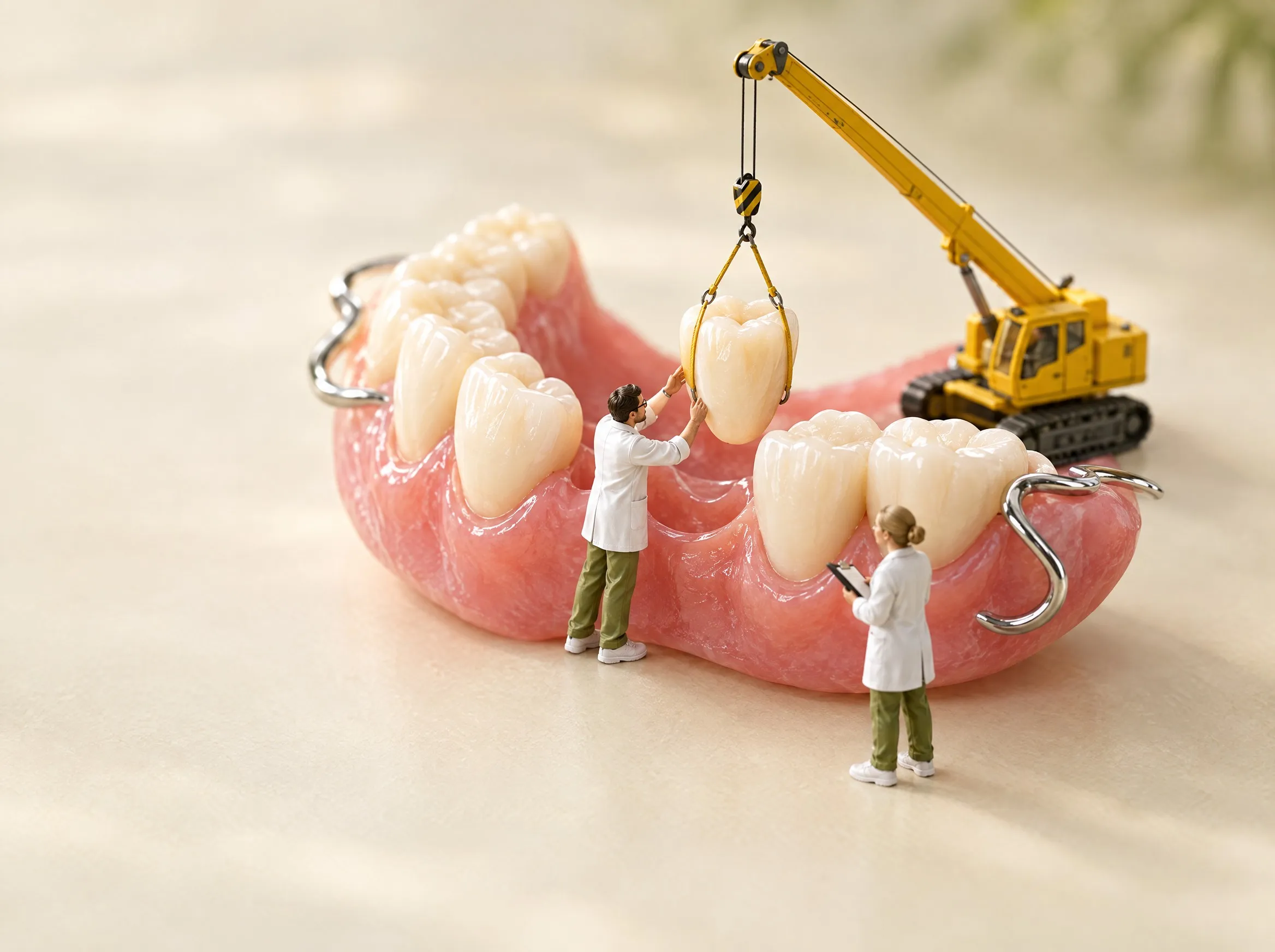
A partial denture replaces one or more missing teeth. It clips onto your remaining teeth to stay in place and comes out for cleaning. We make partials in three materials, so you can choose the one that suits your mouth, comfort and budget.
Why replace missing teeth?
- Neighbouring teeth can drift or tilt into the gap
- Chewing puts extra load on the teeth you have left
- Gaps can affect how you speak and how confident you feel smiling
Choose your partial denture.
Acrylic partial
Teeth set in a gum-coloured acrylic base with small metal clasps. Easy to add teeth to later if you lose more.
Best forAn affordable, adaptable option
Cobalt chrome partial
A thin, strong metal frame that covers less of your palate and feels less bulky.
Best forLong-term comfort and strength
Learn moreFlexible partial
A metal-free, flexible base with gum-coloured clasps that blend in.
Best forA discreet look with no visible metal
Learn more
The three materials side by side.
- Look
- Flexible has no visible metal.
- Comfort
- Flexible and chrome are both less bulky than acrylic.
- Adding teeth later
- Easiest with acrylic, hardest with flexible.
- Strength
- Chrome is the most rigid and durable.
Why choose a partial.
Keep your own teeth
A partial works with your natural teeth rather than replacing them.
Removable
Take it out to clean it and your teeth properly.
Blends in
Teeth and base are matched to your natural smile.
How a partial is made.
Consultation
We check your mouth and remaining teeth, and talk through the three materials.
Impressions
We take moulds so the partial fits around your natural teeth closely.
Try-in
You see and test the teeth before the partial is finished, so you can ask for changes.
Fit
We fit your partial, check the clasps and show you how to put it in and take it out.
Review
We ease any sore spots as your mouth adjusts.
Most patients need around four appointments from consultation to final fit. Depending on your situation, it can be sooner.
Getting used to your new denture.
Most people settle in within a few weeks. These help.
- Start with soft foods cut into small pieces
- Chew on both sides at once to keep the denture steady
- Read aloud to get used to speaking with it
- Take it out at night to rest your gums, unless we advise otherwise
- Come back if anything rubs. Small adjustments make a big difference
Looking after your denture.
A few daily habits keep your denture clean, comfortable and fitting well for longer.
- Rinse it after meals to clear away food
- Brush it every day with a soft brush and a denture cleaner. Regular toothpaste is too abrasive and scratches the surface
- Clean it over a folded towel or a basin of water, so it won't break if you drop it
- Take it out overnight and keep it in water or a soaking solution, so it doesn't dry out and lose its shape
- Never use hot or boiling water, which can warp it
- Brush your gums, tongue and any natural teeth as well
- Take your partial out before brushing your natural teeth, so you can clean around every tooth and clasp
How long will it last?
With good care, many dentures last five to seven years. A denture doesn't so much wear out as stop fitting: your gums and jawbone slowly change shape, while the denture stays the same.
A reline every few years refits it to your mouth as it is today. When the teeth are worn or the base is cracked, a new denture is usually better value, and we'll tell you honestly which makes sense.
Denture relinesWhat will it cost?
The price depends on the type of denture, the material and how many teeth are replaced. Your consultation is free and you'll get a written quote before any work starts. With HICAPS on-site, you can claim on your health fund at the appointment.
Denture costsCommon questions.
Can I get a denture for just one tooth?
Yes. A small partial denture can replace a single missing tooth.
Acrylic or chrome: which is better?
Acrylic costs less and is easy to add to. Chrome is thinner, stronger and usually more comfortable long term. We'll help you weigh it up at your consultation.
Will the clasps show?
Sometimes, depending on where the gap is. We design clasps to be as discreet as possible, and flexible partials avoid metal altogether.
What if I lose another tooth later?
In many cases we can add a tooth to your existing partial rather than make a new one. Talk to us first.
Is a partial bad for my natural teeth?
Not if you keep it and your teeth clean. Take it out to brush, clean around the clasps and keep up regular check-ups so we can check the fit.
Can I eat normally with a partial?
Yes. Start with softer foods cut into small pieces while you get used to it, then build up. Most people settle in within a few weeks.

Close the gap in your smile.
Book at New Town, Kingston or Sorell. HICAPS available.